CapitaLand Integrated Commercial Trust’s H2 DPU rises 9.4% to S$0.0596
[ad_1]
[SINGAPORE] The manager of CapitaLand Integrated Commercial Trust (CICT) on Friday (Feb 6) posted a distribution per unit (DPU) of S$0.0596 for the second half ended December, up 9.4 per cent from S$0.0545 in the year-ago period.
This brings DPU for the 2025 financial year to S$0.1158, up 6.4 per cent year on year. Based on the real estate investment trust’s (Reit) closing unit price of S$2.39 on Dec 31, 2025, CICT’s distribution yield for the full year stood at 4.8 per cent.
The DPU growth came despite an enlarged unit base arising from a private placement last August. The H2 DPU consists of an advanced distribution of S$0.0135 a unit for Jul 1 to Aug 13, which was paid on Sep 18. The remaining DPU of S$0.0461 will be distributed on Mar 24, after the record date of Feb 16.
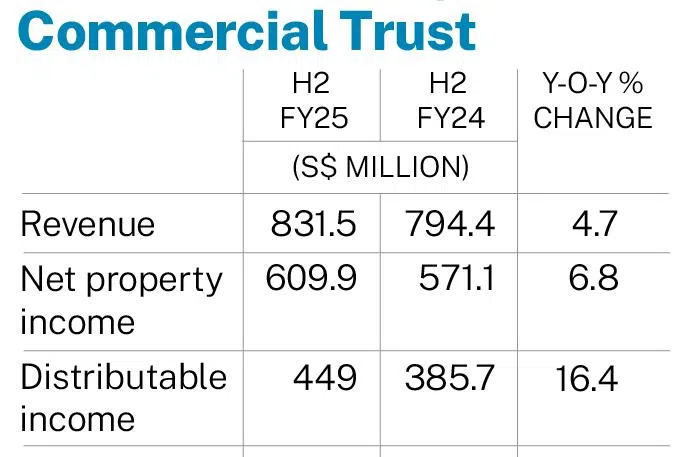
Distributable income for H2 rose 16.4 per cent to S$449 million, from S$385.7 million in the year-ago period.
The increase in DPU and distributable income was driven mainly by contributions from ION Orchard, the step-up acquisition of CapitaSpring’s commercial component, stronger performance from existing properties, and lower interest expenses.
However, it was partially offset by the sale of 21 Collyer Quay in November 2024, said the manager.
Navigate Asia in
a new global order
Get the insights delivered to your inbox.
Revenue for H2 was up 4.7 per cent on the year at S$831.5 million, and net property income (NPI) was higher 6.8 per cent year on year at S$609.9 million.
For the full year, distributable income rose 14.4 per cent to S$860.9 million, from S$752.2 million previously. Revenue was up 2.1 per cent at S$1.62 billion, and NPI climbed 3.1 per cent to S$1.19 billion.
“We have deployed multiple growth levers to create value – through asset enhancement initiatives (AEI), portfolio reconstitution and now a new development project,” said Tan Choon Siang, chief executive officer and executive director of the manager of CICT.
A new AEI that the Reit is embarking on is at Capital Tower in Singapore. The S$25 million refurbishment, which will run from the third quarter of 2026 to Q4 2027, will reposition Level 9 into a community space and create a higher-yielding food and beverage (F&B) area on Level 1.
In Germany, CICT began carrying out an AEI on its 38-storey Grade-A office building Gallileo in February 2024. The progressive handover of office space to anchor tenant European Central Bank in December 2025 has made Germany a more stable market for the trust, said Tan. The second phase of handover is targeted for Q1 2026.
On divestments, Tan said at an earnings briefing that the trust will start reviewing some assets outside of Singapore, but that will depend on conditions in their respective markets.
As Gallileo will start contributing income to the Reit, there is no urgency to divest the asset, he added. Still, he pointed out that CICT has another German asset – Main Airport Center, in which it holds a 94.9 per cent stake – that could be considered for sale, depending on market conditions.
New development
CICT will be developing and owning 100 per cent of the commercial component of the Hougang Central site that it won alongside its joint venture partners CapitaLand Development, UOL , Singapore Land and Kheng Leong.
Spanning about 300,000 square feet of net lettable area, the project is “well-placed” to cater to the precinct’s sizeable and underserved catchment. It is expected to generate an attractive entry yield of over 5 per cent, said Tan, and will expand the trust’s retail presence in the north-east region.
He added that the development will not reduce distributable income or sacrifice NPI. While its gearing will increase, CICT is comfortable with the 37.6 per cent figure, following the sale of Bukit Panjang Plaza for S$428 million. This leaves sufficient headroom to fund the project without affecting other redevelopment initiatives.
As at end-December, the Reit’s gearing level stood at 38.6 per cent, down 0.6 percentage point from that recorded on Sep 30.
The average cost of debt was 3.2 per cent, and some 74 per cent of the Reit’s total borrowings are on fixed interest rates. As at Dec 31, CICT had an interest coverage ratio of 3.7 times.
When asked about interest in the northern region, Tan said the trust evaluates development opportunities case by case. “It always helps for us to expand our customer base… The more malls we have across Singapore, the wider the selection and offerings we can provide.”
While there has been market talk that malls in the northern region could be affected by the upcoming RTS Link, Tan said CICT’s minimal exposure in the area means it is unlikely to be significantly affected, and visitor inflows could add vibrancy to the malls.
Growth drivers
For FY2025, the trust recorded an average reversion of 6.6 per cent for both its Singapore retail and office portfolios.
Although the H2 results demonstrated “solid all-around improvement”, Citi analyst Brandon Lee on Friday noted that a sequential slowdown in rental reversions for both office and retail implied a “certain level of friction in negotiating for higher rents during the current late part of an upcycle for both sectors”.
Leases executed in suburban malls in FY2025 had positive rental reversion of 7.2 per cent, accounting for 7.4 per cent of the Reit’s committed retail leases.
Downtown malls, such as Bugis Junction, posted positive rental reversion of 6.2 per cent, making up 13.1 per cent of committed leases.
Tenant sales per square foot (psf) across CICT’s retail portfolio rose 14.9 per cent on the year. Excluding ION Orchard, however, tenant sales psf growth was 1.2 per cent.
Retail portfolio occupancy remained strong at 98.7 per cent, while shopper traffic rose 20.5 per cent in FY2025.
While F&B closures have been grabbing headlines in the past year, CICT portfolio management head Lee Yi Zhuan said rental reversions of around 6 per cent are “digestible”, with most tenants able to sustain their operations provided that their business models are sound.
Those that fail would typically struggle even without rent increases, as modest escalations of 2 per cent are unlikely to affect business sustainability, he added.
CICT’s adjusted net asset value per unit was S$2.09 as at end-December, up 1 per cent from S$2.07 as at Jun 30.
Tan highlighted interest rates and the economy as key risks for 2026. While the Singapore Overnight Rate Average has eased and the Republic’s interest environment remains relatively stable, any uptick in global rates could put pressure on borrowing costs.
He noted that strong gross domestic product growth last year defied earlier recession forecasts, and continued government stimulus measures may influence retail demand in 2026.
Units of CICT were trading 3.8 per cent or S$0.09 higher at S$2.47 as at 3.28 pm on Friday.
Decoding Asia newsletter: your guide to navigating Asia in a new global order. Sign up here to get Decoding Asia newsletter. Delivered to your inbox. Free.
[ad_2]
Source link