STI, key Asian markets tumble after strikes on Iran; bank stocks drop, energy names surge
[ad_1]
Iran is preparing for a ‘crushing retaliation’, according to a Reuters report on Saturday, such that reconciliation with the West is not in sight
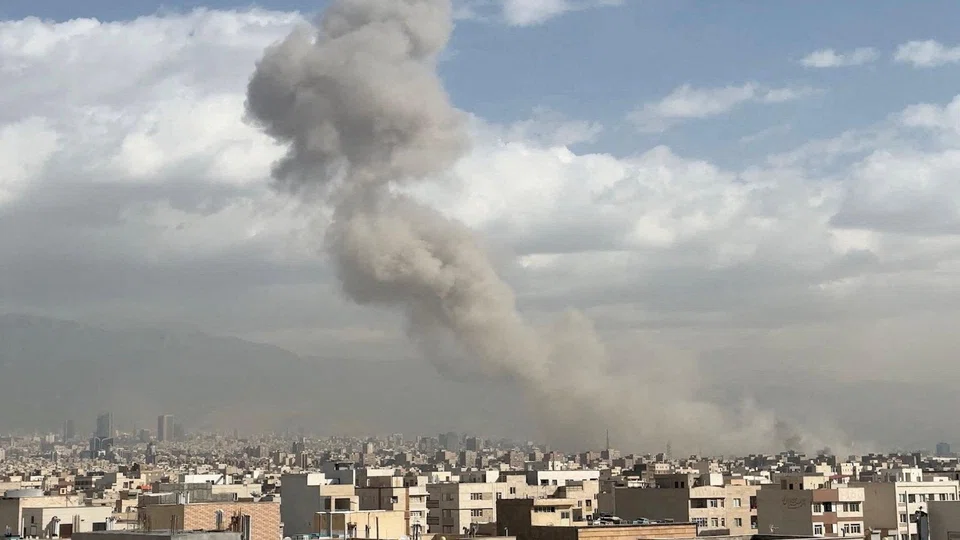
[SINGAPORE] Asia markets were trading lower at midday on Monday (Mar 2), after the latest US-Israel attacks on Iran over the past weekend.
This comes after a 12-day air war in June 2025 between Israel and Iran and multiple US-Israeli warnings of more strikes if Iran pressed ahead with its nuclear and ballistic missile programmes.
Ayatollah Ali Khamenei, the supreme leader of Iran, was declared dead earlier on Saturday, alongside several other leaders of the country.
Iran is preparing for a “crushing retaliation”, according to a Reuters report on Saturday, such that reconciliation with the West is not in sight.
Thousands of flights globally have been disrupted due to the most recent strikes, where key transit airports in Dubai and Doha in Qatar were shut or severely restricted, as the region’s airspace stayed closed.
This has affected 26 Singapore Airlines (SIA) and Scoot flights between Feb 28 and Mar 7, which have now been cancelled. Other SIA flights could be affected, too, amid the fluid situation, said the national carrier in a Facebook post on Sunday.
Navigate Asia in
a new global order
Get the insights delivered to your inbox.
The Straits Times Index pared some losses by midday on Monday, trading 1.8 per cent or 89.51 points lower at 4,905.56.
Local bank counters continued to be a sea of red in the afternoon. DBS was down 2.1 per cent at S$55.92 and OCBC declined 2.2 per cent to reach S$20.96. UOB also fell 1.8 per cent to hit S$36.31.
Singapore Airlines was down 5 per cent in early trade, and continued to drop to S$6.75, trading about 6 per cent lower as at 9.05 am before last trading 5.7 per cent down. The counter pared losses at midday, trading 4.6 per cent lower at S$6.85.
SEE ALSO
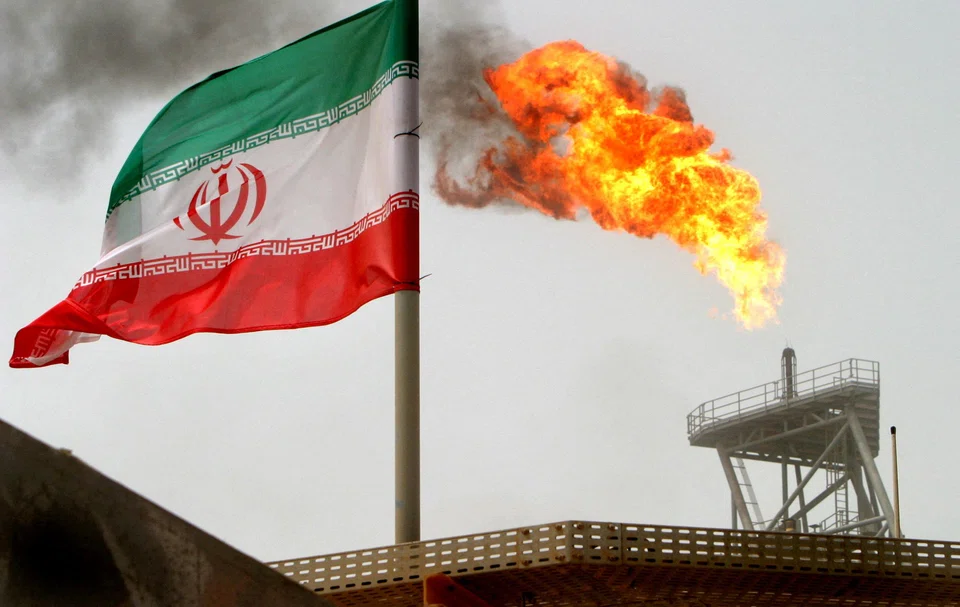
Energy counters such as RH PetroGas surged 20 per cent to S$0.198 by 1.51 pm, and Geo Energy Resources rose 2.4 per cent or S$0.01 to S$0.425. Oil and gas exploration service Rex International was trading 14.5 per cent higher at S$0.166 at midday.
Defence name ST Engineering was also up 1.6 per cent at S$10.13 as at 9.30 am, before rising to S$10.38 at midday, trading 4.1 per cent higher.
Gold investment-related stocks such as CNMC Goldmine spiked 12.1 per cent to S$1.94 as at 1.52 pm, and jeweller Aspial Lifestyle was up 5.5 per cent at S$0.385.
In Japan, the Nikkei 225 dropped 1.7 per cent, while the Topix was down 1.3 per cent in early trade.
South Korean markets are closed due to a public holiday. Hong Kong’s Hang Seng Index was down 1.7 per cent at midday.
The Shanghai CSE 300 Index declined 0.3 per cent, and Australia’s ASX 200 inched down 0.4 per cent.
Dow Futures declined over 500 points, or 1.2 per cent. S&P 500 futures also fell 1 per cent, and Nasdaq 100 futures was down over 1 per cent in overnight trading.
Meanwhile, spot gold prices rose 1.6 per cent to US$5,364.35 in the afternoon, while Bitcoin has slumped to US$66,868, amid this period of renewed uncertainty.
WTI Crude Oil futures jumped 6.3 per cent at midday, while Brent Oil was up 6.5 per cent at US$77.64 per barrel.
Gold, silver, O&G names standout
Navigating global equity markets is now tricky, amid the current situation between US-Israeli forces and Iran, experts note.
“The immediate impulse is higher crude and natural gas prices — in addition to (that of) liquified natural gas (LNG),” said Franklin Templeton analysts in a Saturday note.
This comes as Qatar has the world’s third-largest LNG export capacity, and around 20 per cent of global LNG trade which transits the Strait of Hormuz, making shipping risk a gas-market event, as much as an oil-market event.
Sector dispersion is therefore likely to dominate, according to Julius Baer’s head of research Christian Gattiker, where cyclicals, consumer-facing industries, chemicals and transport remain most exposed to sustained energy cost pressure.
“Meanwhile, oil and gas stocks have historically provided a partial hedge against supply-driven price spikes – an area investors may want to look at from a portfolio-construction perspective, even if we do not actively advocate an overweight,” he added on Monday.
That said, oil prices may well remain “well-behaved”, too, with a supply backstop from Opec+ (Organization of the Petroleum Exporting Countries and allies like Russia), which has indicated it could increase production at its upcoming meeting, noted Afdhal Rahman, executive director of wealth advisory at OCBC.
Regardless, it is now clear that the conflict escalation has fuelled a “bullish mood” in gold and silver.
This is because they support prices and stabilise a portfolio at a time of “heightened volatility” and uncertainty in financial markets, said Gattiker.
“Whether or not there will be more upside from these levels…depends on if the conflict stays contained to the presently involved countries, or if it spreads within the (Middle East) region,” he added, citing how the house keeps its views on being “constructive” on gold, and “neutral” on silver.
Proceed with caution
Various analysts have warned investors not to make hasty investment decisions amid the present “short-run” conditions.
“We would not yet label this a clean buy-the-dip setup, as duration, shipping/insurance mechanics, and the endgame matter more than the first headline,” said market strategists from Franklin Templeton.
Clear political incentives frame this argument, with US mid-term elections approaching this year, and an electorate fatigued and sceptical of “forever wars,” said OCBC’s Rahman.
“The Trump administration has an incentive to keep the conflict contained and brief,” he added.
Still, while the mid-term elections argue against a protracted conflict, uncertainty remains high, indicated Julius Baer’s Gattiker.
“Against the current backdrop, chasing short-term moves appears less attractive than maintaining discipline: a defensive bias remains warranted until greater clarity on the trajectory of the conflict emerges.”
Decoding Asia newsletter: your guide to navigating Asia in a new global order. Sign up here to get Decoding Asia newsletter. Delivered to your inbox. Free.
[ad_2]
Source link