HILL: Smith government should focus on what it can control — spending
Article content
Next month, amid weak oil prices and uncertainty fuelled by recent developments in Venezuela, which could depress prices further, the Smith government will table its 2026 budget. Albertans should brace themselves; every $1 drop in oil prices is a $750 million hit to the Alberta government’s bottom line, and the outlook isn’t bright.
Article content
Due in large part to factors outside of the provincial government’s control (global supply and demand, geopolitical instability, policy changes in other countries, etc.), resource revenue (e.g. oil and gas royalties collected by the Alberta government) is inherently volatile.
Article content
Volatile revenue stream
For perspective, just a few years ago in 2022-23, oil prices were US$89.69 per barrel, resource revenue was $25.2 billion and the Alberta government enjoyed an $11.5-billion budget surplus. But after a few years of relatively high resource revenue and budget surpluses, in 2025-26 the government projects oil prices will average US$61.50 per barrel, resource revenue will be $15.4 billion and the government will incur a $6.5-billion budget deficit. And again, the outlook moving forward is bleak. Deloitte forecasts oil prices will average US$58.00 per barrel in 2026 before rising modestly to US$61.20 per barrel in 2027. In the shorter term, the U.S. intervention in Venezuela could push prices lower due to uncertainty alone, and in the longer term, potential greater supply of heavy crude (Venezuela holds the largest crude oil reserves on Earth) could add to the downward pressure.
Article content
This is precisely why it’s so important to make prudent fiscal decisions during the good times. But instead, for decades successive Alberta governments have increased spending during the good times, which becomes unsustainable without deficits when resource revenues inevitably fall. While the Smith government has shown important restraint in recent years, it simply isn’t enough to get spending levels where they need to be to avoid this vicious cycle, which ultimately costs Albertans.
Indeed, deficits fuel debt accumulation, which taxpayers must finance. Back in 2008-09 when Alberta was effectively debt free, the government’s debt interest costs were negligible ($58 per Albertan). Now in 2025-26, projected debt interest costs ($3 billion) are nearly $600 per Albertan — money that could instead pay for services such as health care or make fiscal room for tax relief.
So, what’s the solution?
Need smarter spending
The government should not base permanent spending levels on relatively high — but incredibly volatile — resource revenue. Put simply, the government must align spending with more ongoing stable levels of revenue. Fortunately, there’s some clear first steps. Government employee compensation, for instance, accounts for roughly 50% of the government’s total operating spending, and has climbed in recent years as the number of government jobs has increased. Reducing the number of government jobs through attrition and a program review could produce savings. Then there’s business subsidies (a.k.a. corporate welfare). The Alberta government spends billions of taxpayer dollars annually on select business and industries. As this type of corporate welfare does little if anything for widespread economic growth, it’s ripe for cutting.
Read More
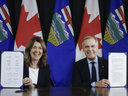
Oil prices meaningfully impact the Alberta government’s budget, and unfortunately, the price outlook is bleak. Next month, when the Smith government tables its next budget, it should focus on what it can control and meaningfully reduce spending.
Tegan Hill is director of Alberta policy at the Fraser Institute.
Share this article in your social network