'No bollards in place.' Second crash at St. David's hospital in Austin months after deadly incident
[ad_1]
Project Summary:
This story is part of KXAN’s “Preventing Disaster” investigation, which initially published on May 15, 2024. The project follows a fatal car crash into an Austin hospital’s emergency room earlier that year. Our team took a broader look at safety concerns with that crash and hundreds of others across the nation – including whether medical sites had security barriers – known as bollards – at their entrances. Experts say those could stop crashes from happening.
.anvato_caption {
font-size: 0.75em;
color: rgb(102, 102, 102);
font-style: italic;
line-height: 1.2em;
padding: 0px;
margin-top: -.5em;
}
AUSTIN (KXAN) — Two months after a deadly crash at St. David’s North in February of last year, there was another incident at the hospital system’s south location. A KXAN investigation uncovered the previously unreported crash is among at least five incidents in recent years, some deadly, at medical facilities run by HCA Healthcare, the for-profit ownership partner of St. David’s HealthCare.
‘Where the van hit, we had no bollards in place’

A nursing van rests against a side wall at St. David’s South Austin Medical Center on April 10, 2024. (Source Photo)
KXAN reviewed surveillance video, photos and emails obtained from a source, along with public records like 911 calls, radio recordings, dispatch notes and the crash report from the Texas Department of Transportation to learn more about the April 10, 2024 crash at St. David’s South Austin Medical Center.
The overhead surveillance video, aimed at the Women’s Center north entrance parking area, shows a white nursing transit van waiting to drop off a patient at 11:48 a.m. At some point, someone honked, according to investigators, and the driver “quickly accelerated.” The video shows the van careening into another car before hopping a curb onto a landscaped area.
Photos show the aftermath: The van on a ledge near the hospital’s side wall, next to a window and an outdoor seating area. An arriving firefighter remarked over the radio, sounding surprised: “We’ve got a van that is leaning right up against the building.”
“The driver still is in there,” a woman told 911. “We have some healthcare workers trying to get them out.”
St. David’s HealthCare said no patients, guests, employees or physicians inside were injured.
“This incident occurred in a location that was not a pedestrian entrance,” a spokesperson said, “and bollards would not have prevented this.”

More than 30 bollards now line the entrance to St. David’s South Austin Medical Center’s north entrance. (KXAN Photo/Chris Nelson)
Two people inside the van were moved inside the ER to be examined for potential injuries, before Austin Fire and EMS arrived, according to the Austin Fire Department.
The next day, in an internal email we obtained from a source, a top official at the hospital asked about bollards, describing the incident as “a very near miss.”
“It was inches from going through windows and hitting several physicians who were charting in our physician lounge,” said St. David’s South’s Vice President of Operations Julia Poirier.
Poirier mentioned a bollard “audit” and funding St. David’s North received for them after its deadly ER crash.
“Where the van hit,” she warned, “we have no bollards in place.”

An email from St. David’s SAMC vice president of operations described the van crash as “a very near miss.” (Source Photo)
In response, St. David’s Vice President of Corporate Services Mark Worsham said “yes” bollards would be funded once they get a “recount on the number you need including the area where the van entered the ground.” Worsham mentioned they need to “match” what was installed at St. David’s North.
The hospital system will not say how many bollards St. David’s South had at the time, how many were added after, and if any are crash-rated to stop another incident. KXAN Investigates counted 33 bollards on a recent visit to the north entrance. Its other entrance is also lined with bollards.
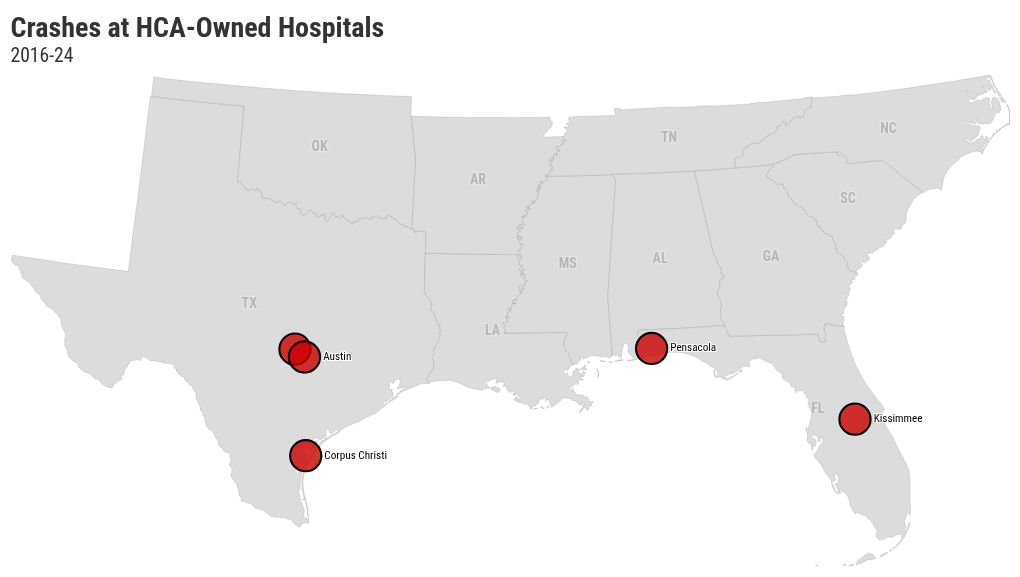
These two crashes, two months apart — neither with barriers at the points of impact at the time — are among at least five crashes at HCA-owned hospitals nationwide since 2016, a KXAN analysis found.

A KXAN interactive map showing crashes KXAN found at HCA Healthcare-owned hospitals across the country from 2016-2024. (KXAN Interactive/Christopher Adams)
Crashes at HCA-owned hospitals
Using data from the nonprofit Storefront Safety Council, TxDOT, police, EMS and media reports, a KXAN analysis previously found more than 20 deaths and 400 crashes involving medical sites across the country over the past decade — a startling statistic that state lawmakers recently highlighted.

A KXAN analysis found, overall, more than 20 deaths from crashes at medical sites since 2014 in these states. (KXAN Graphic/Wendy Gonzalez)
On April 20, 2023 — a year before the incident at St. David’s South and 10 months before the incident at St. David’s North — a patient drove her SUV into the ER entrance at HCA Florida Osceola Hospital in Kissimmee, “reversed” and drove through “a second time,” according to the police report.
Authorities say the woman refused to leave moments before over a medication dispute. In body camera video, the patient can be heard sobbing, “I just need my medicine.”

A KXAN analysis found, overall, more than 400 crashes involving medical sites since 2014 in these states. (KXAN Graphic/Wendy Gonzalez)
“She’s like, ‘I can’t believe they don’t want to give me my medication, I’m leaving,'” an officer on scene recounts. “She got in her car and literally came through this way.”
The patient was arrested and charged with criminal mischief, trespassing, obstructing an officer without violence and a charge related to driving into the building. She spent two days in jail and was sentenced to two years supervised probation, records show.
KXAN asked HCA Florida Osceola Hospital how many bollards it had at the time and if it considered adding any after the incident — including at the point of impact. The hospital did not respond.

On Dec. 28, 2021, a 25-year-old pregnant woman died, but her baby survived, when the car she was riding in crashed through a traffic arm and into a wall at HCA-owned Corpus Christi Medical Center Bay Area, according to published reports. (Courtesy KRIS-TV) 
On April 20, 2023, a 31-year-old patient crashed into the ER entrance of HCA Florida Osceola Hospital, twice, after being asked to leave following a medication dispute, according to the crash report. (Kissimmee Police Photo) 
On Feb. 13, 2024, a 57-year-old woman, whose blood-alcohol level was between 3-4 times the legal limit to drive, according to the toxicology report, crashed through the ER entrance at HCA-owned St. David’s North Austin Medical Center, killing herself and seriously injuring five people inside the lobby. (Austin Police Photo) 
On April 10, 2024, a driver of a nursing van waiting to drop off a patient “quickly accelerated” when someone honked, hopped a curb onto a landscaped area and crashed into a side wall next to a window where physicians were working at HCA-owned St. David’s South Austin Medical Center, according to the crash report, photos, surveillance video and an internal email. (Source Photo)


On Nov. 21, 2016, a 56-year-old man died after crashing into a wall near the ER entrance at HCA West Florida Hospital in Pensacola, according to published reports.
And on Dec. 28, 2021, a 25-year-old pregnant woman died when the car she was riding in crashed through a traffic arm and into a wall at HCA-owned Corpus Christi Medical Center Bay Area. The baby she was carrying survived, according to published reports.
‘Hospitals are primed to be hit’
These examples show it’s not just ER entrances that are at risk, according to perimeter security consultant and vehicle barrier expert Jeffrey Halaut of Wimberley. He said hospitals need to be better prepared, more broadly, with bollards.
“Hospitals are primed to be hit,” said Halaut with Halaut Consulting Security Solutions. “The fact that it’s not being done is ludicrous at this point.”
Halaut, who has decades of experience in construction security and specializes in perimeter security design, said there are many reasons why hospitals are vulnerable.

Perimeter security consultant Jeffrey Halaut of Wimberley testified in front of a Senate panel in March in favor of S.B. 660, which would require crash-rated bollards at most Texas hospitals. (Texas Senate Photo)
“Whether it’s intentional — because someone’s mad about their health insurance — or whether it’s accidental — because somebody doesn’t want to call an ambulance and pay the ambulance fee, so they decide, with a heart attack, to drive themselves to the emergency room,” he said. “There’s been hundreds of reasons for it to happen. It’s only growing.”
In March, Halaut testified at the Texas Capitol in support of Senate Bill 660.
He told the same Senate panel KXAN was invited to testify in front of about our investigations that bollards are “cost-effective, minimally disruptive and proven to save lives.”
The bill, filed by Sen. Royce West, D-Dallas, backed by the Texas Nurses Association and sparked by KXAN’s investigations, would require crash-rated bollards at most hospitals around the state. It exempts hospitals located in rural areas with a population size of 68,750 or fewer, hospitals with 100 beds or fewer, and facilities that already have crash-rated bollards or “another similar safety barrier” in place.
In April, the bill cleared the Senate. It is now awaiting debate in the House.
“It’s far past time,” Halaut said of the statewide bollard proposal. “I hope this is just the start of things to come.”

666) {
// headerImg = ` `;
`;
// headerImg = ` `;
`;
headerImg = ` `;
`;
} else {
// headerImg = ` `;
`;
// headerImg = ` `;
`;
// headerImg = ` `;
`;
headerImg = ` `;
`;
}
var cat4markup = `${headerImg}`;
// $(“div.site-content__layout”).prepend(cat4markup);
// $(“div.site-content__layout”).prepend(cat4markup);
$(“header.article-header”).prepend(cat4markup);
// –>
.nlp-ignore-block.article-content.rich-text {
margin-bottom: 0;
}
#_hero_banner {
/* height: 30.25vw;*/
/* border: 1px solid #ffffff; */
}
#content > div.site-content__header > header > a > img {
max-width: 1120px;
width: 100%;
display: block;
margin: 0 auto 1em auto;
}
@media only screen and (max-width:641px) {
#_hero_banner_mobile {
/* height: 30.25vw !important; */
height: unset !important;
border: 1px solid #ffffff;
}
}
KXAN reached out to St. David’s parent company, HCA, eight times since March by phone and email. We wanted to know about its prior crashes and what it would take to consider a system-wide bollard policy across its nearly 200 hospitals and 2,400 care sites to protect patients. As of this report, HCA has yet to respond.
St. David’s referred our bollard-related questions to the Texas Hospital Association — an industry group that testified against the bollard safety bill to a Senate panel and described it in an online post as a “one-size-fits-all mandate.”
“Singling out hospital emergency rooms to install bollards would not prevent, based on the statistics we’re aware of, the overwhelming majority of these types of accidents,” THA Senior Vice President and General Counsel Steve Wohleb told lawmakers in March, referencing the frequency of crashes at business storefronts.
“Because,” Wohleb added, “they simply don’t occur in hospitals.”
Digital Data Reporter Christopher Adams, Graphic Artist Wendy Gonzalez, Director of Investigations & Innovation Josh Hinkle, Investigative Producer Dalton Huey, Investigative Photojournalist Chris Nelson, Digital Special Projects Developer Robert Sims and Digital Director Kate Winkle contributed to this report.
:root {
–background_color: #ffffff;
–copy_color: #000000;
–box_border: #aaaaaa;
–story_link_color: #f6cc7b;
–promo_link_color: #f6cc7b;
–figcaption_color: #aaaaaa;
–widget_bg_color: #552e31;
–widget_link_color: #ffffff;
–widget_thumbnail_category: #212121;
–widget_headline_category: #ffffff;
–widget_read_more_color: #ffffff;
–widget_read_more_bg_color: #891d10;
}
body {
background-color: var(–background_color);
color: var(–copy_color);
background-image: url(‘https://www.kxan.com/wp-content/uploads/sites/40/2024/05/PREVENTING-DISASTER_WALLPAPER.png’);
background-repeat: no-repeat;
background-attachment: fixed;
background-position: center top;
}
#primary a {
color: #cc0000;
text-decoration: none;
}
#primary a:hover {
color: #cc0000;
text-decoration: underline;
}
#primary a:visited {
color: #cc0000;
text-decoration: none;
}
header.page-header {
display: none;
}
@media only screen and (max-width:666px) {
body {
background-image: none;
}
#_hero_banner {
margin-bottom: 0;
}
}
<!– This needs to be in a single HTML block. Don’t replicate it in other blocks –>
<!– This needs to be in a single HTML block. Don’t replicate it in other blocks –>
{
node.style.display = ‘inline-block’;
});
const appFleft = document.querySelectorAll(‘.app_fleft’);
const appFright = document.querySelectorAll(‘.app_fright’);
const appBlockW = document.querySelectorAll(“[class*=’app_width|’]”);
// // console.log(appFright);
const calloutBox = document.querySelectorAll(‘.app_friendly_callout_box’);
const appCaptionBlock = document.querySelectorAll(“.app_friendly_caption_block”);
const appCaptions = document.querySelectorAll(“.app_friendly_caption_block > p”);
if (window.screen.width > 666) {
// kill mobile specific elements
const kxanMobileAssets = document.querySelectorAll(‘.kxan_mobile’);
kxanMobileAssets.forEach((node) => {
node.style.display = ‘none’;
});
calloutBox.forEach((node) => {
node.style.margin = ‘0 0 1em 0’;
});
appCaptions.forEach((node) => {
// node.style.padding = “0 0 1em 0”;
node.style.padding = “1em 0 1em 0″;
});
appFleft.forEach((node) => {
node.style.float=”left”;
node.style.marginRight=”1em”;
});
appFright.forEach((node) => {
node.style.float=”right”;
node.style.marginLeft=”.75em”;
node.style.marginRight=”0″;
// node.style.textAlign = ‘right’;
});
appBlockW.forEach((node, idx) => {
// console.log(node.className);
let classStr = node.className;
let imgW = classStr.split(“|”)[1];
// console.log(‘|’ + imgW + ‘|’);
node.style.width = imgW + ‘%’;
});
} else {
// kill desktop specific elements
const kxanDesktopAssets = document.querySelectorAll(‘.kxan_desktop’);
kxanDesktopAssets.forEach((node) => {
node.style.display = ‘none’;
});
appFleft.forEach((node) => {
node.style.float=”none”;
node.style.margin = ‘.75em 0’;
});
appFright.forEach((node) => {
node.style.float=”none”;
node.style.margin = ‘.75em 0’;
});
calloutBox.forEach((node) => {
node.style.width=”100%”;
});
appCaptionBlock.forEach((node) => {
node.style.width=”100%”;
});
appBlockW.forEach((node, idx) => {
// console.log(node.className);
// let classStr = node.className;
// let imgW = classStr.split(“|”)[1];
// console.log(‘|’ + imgW + ‘|’);
node.style.width=”100%”;
});
}
// –>
.anvato_caption {
font-size: 0.75em;
color: rgb(102, 102, 102);
font-style: italic;
line-height: 1.2em;
padding: 0px;
margin-top: -.5em;
}
figure.ns-block-embed-anvato {
box-shadow: 0px 0px 10px 0 rgba(0, 0, 0, 0), 0px 0px 10px 0px rgba(0, 0, 0, 0.4);
}
[ad_2]
Source link